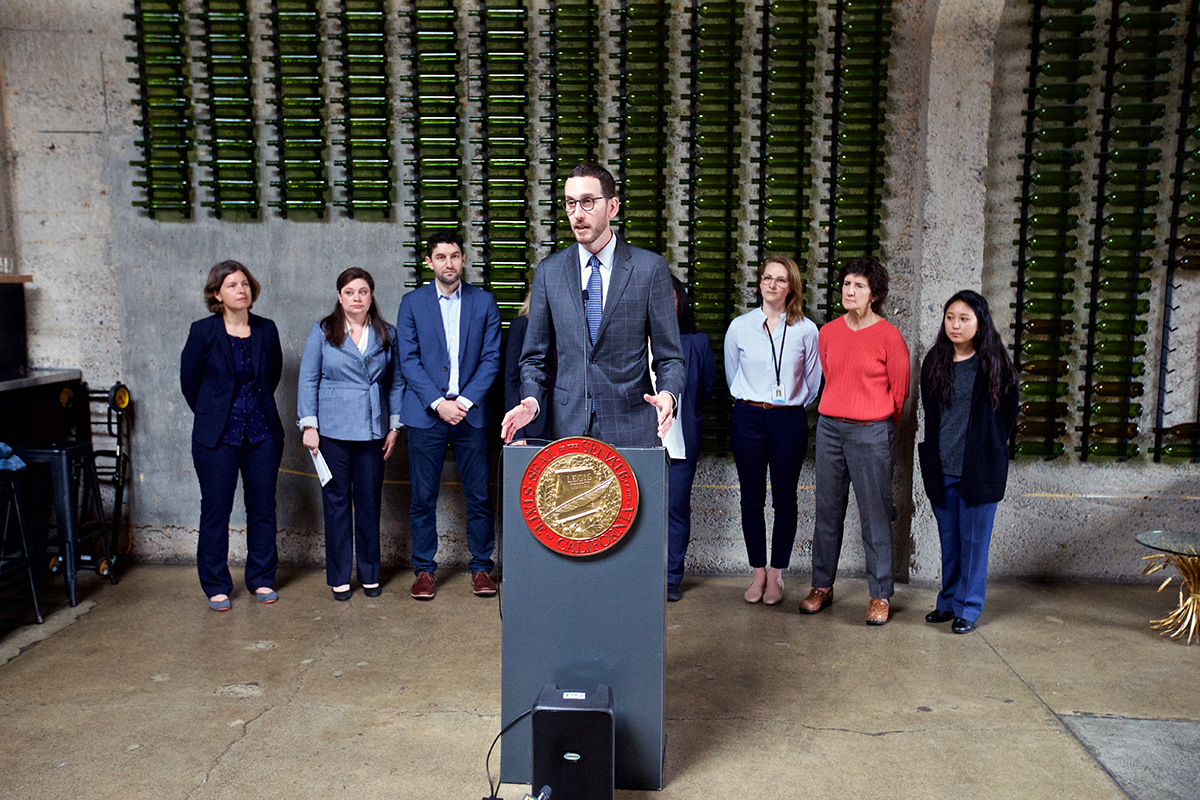
On January 28, 2019, California State Senator Scott Wiener (D), together with Senators Glazer (D) and Stone (R) and Assembly Member Voepel (R), introduced Senate Bill 166—a bipartisan bill aimed at clearing the path for California breweries and wineries to conserve massive amounts of water and save money in the process. Today, on average, it takes five to seven gallons of water to produce one gallon of beer or wine. In 2016, California craft breweries alone produced 3,295,221 barrels of beer amounting to roughly 313 acre-feet of water. (There are about 31 gallons in a barrel of beer.) Over 17 million gallons of wine
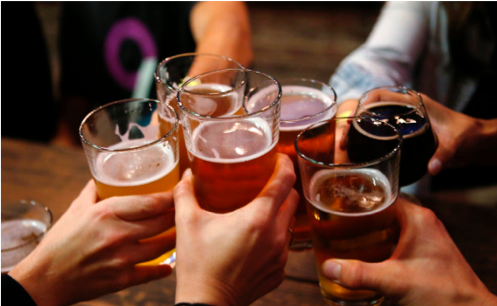
Because these industries are water-intensive, there is great opportunity to make more efficient use of all water resources. As a result, many breweries and wineries are seeking guidance from state policymakers on how they can better reuse their “process water” generated onsite for both potable and non-potable applications. Reusing process water not only cuts potable water consumption, reducing demand on the local water
Yet, currently
there are no uniform health and safety standards in California for breweries
and wineries to reuse their process water onsite, making the existing case-by-case
administrative procedure to do so difficult and expensive. SB 166 would help
eliminate this barrier by standardizing health and safety requirements for
reusing process water at breweries and wineries statewide. In particular, the
bill would require that the State Water Resources Control Board in consultation
with State Department of Public Health – Food and Drug Branch adopt regulations
for microbiological, chemical, and physical water quality and treatment
requirements for the onsite treatment and reuse of process water in breweries
and wineries by December 2025.
This
guidance is especially important given that in May 2018 California set its most
recent water
efficiency requirements now providing, in part, that urban water
agencies meet local water budgets for their services areas and set performance
measures for local industry. By establishing guidance for California breweries
and wineries on how they can better reuse process water, SB 166 is a great step
forward as water providers work to meet these new requirements and move towards
even more efficient use of all of our State’s water resources. This bill will
also provide a basis for state and local leaders, as well as local water agencies,
to work with beverage industry leaders that are rising to the challenge of more
efficient water use and connect innovators to solutions. These types of
partnerships are an important part of securing California’s water future, which
will rely on the widespread adoption of the type of localized, onsite
strategies fostered by SB 166.
And
WaterNow is no stranger to water-efficient beer making. In 2017, we partnered
on the AZ Pure Water
Brew Challenge—a statewide public outreach campaign to better inform
Arizonans about technologies currently available to purify recycled wastewater
producing safe, high-quality drinking water. This extremely successful campaign
helped citizens understand and accept water reuse.
Solutions
like this aimed at advancing resilient water systems and maintaining accessible
clean water for everyone are at the center of WaterNow’s Tap into Resilience
campaign. Tap into Resilience is focusing on how to support communities,
businesses, and individuals accelerating adoption of innovative sustainable
water strategies. We are encouraged that SB 166 will move California in this
direction and is an example for others across the country facing similar
challenges.