Application Process
The application process for the two Colorado SRFs involves 4 stages that applicants must complete to meet state and federal requirements. Pre-qualification to loan submittal takes about 12-18 months
The application process for the two Colorado SRFs involves 4 stages that applicants must complete to meet state and federal requirements. Pre-qualification to loan submittal takes about 12-18 months
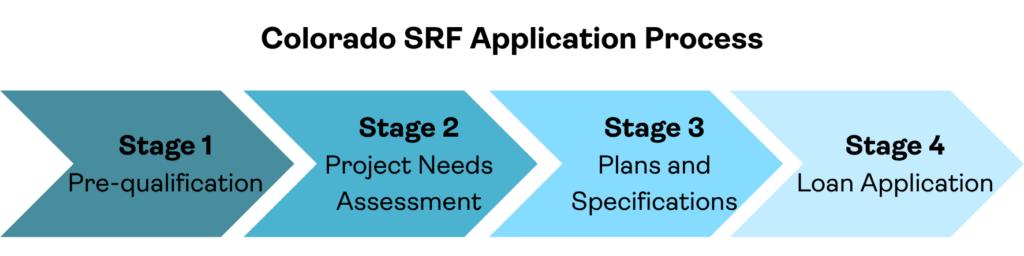
Stage 1: Pre-Qualification:
The pre-qualification phase for both the DWRF and WPCRF loan application includes four steps:
Stage 2: Project Needs Assessment
After pre-qualification, applicants must submit a Project Needs Assessment through the online portal. The PNA provides detailed technical, financial, and environmental information about the proposed project to confirm eligibility for SRF funding.
Note: DWRF applicants must also complete a Technical, Managerial, and Financial (TMF) capacity assessment as part of the PNA.
Stage 3: Plans and Specifications
Applicants submit final project plans and specifications, including design documentation and required compliance forms, prior to bidding and construction.
Key components include:
Stage 4: Loan Application
Applicants submit a formal loan application during one of several application cycles throughout the year. Applications are accepted on a rolling schedule, with some cycles open to all applicants and others limited based on project priority ranking.
To apply, applicants must:
Applications are accepted several times throughout the year, typically every 1–2 months, with both open and limited funding rounds.
View current deadlines and application details on the CDPHE website.
Federal law requires Colorado’s Water Pollution Control SRF to provide at least 10% of its annual funds to the Green Project Reserve (GPR), and the state can fund green projects at higher levels if it chooses. Projects eligible for the GPR include green stormwater infrastructure, water efficiency, energy efficiency, or other environmentally innovative activities.
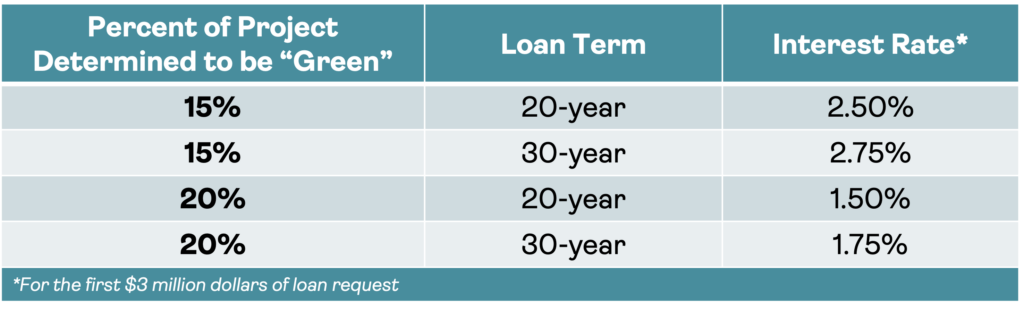
Green projects are automatically considered in each WPCRF loan application cycle throughout the year and may receive up to 40 additional points in the prioritization process. This is a key issue because these extra points can improve your project’s ranking on the Project Priority List (PPL), and in some cases, increase the likelihood of receiving principal forgiveness. GPR-eligible projects may qualify for reduced interest rates on the first $3 million of the loan request, as shown below.
Through 2026, the federal Drinking Water SRF program provides dedicated funding for lead service line replacement and emerging contaminants of concern. A significant portion of this funding is being provided as grants or principal forgiveness, including:
As of May 2026, there is no indication that these funds will be renewed.